

Dear Fellow Investors and Friends,
Welcome to another edition of my newsletter, where I share my efforts to understand markets and the world around me.
I do appreciate you taking the time to read this. Feedback is welcome; it’s great to start conversations.
Today is Thursday, July 24th, the 205th day of the year. There are 160 days until the end of the year. On this day in 1969, Apollo 11, the first crewed mission to land on the Moon, splashed down safely in the Pacific Ocean after its historic journey. I saw these pictures on X this week:


They were taken only 65 years apart! What’s even more astonishing is that the second image is 56 years old. What events occurred in the meantime? When looking at it this way, instead of being impressed by man’s ability to land on the moon, shouldn’t we feel disappointed by our lack of progress since then?
It’s an example of the power of the mental model of inversion.
It tackles problems by considering the opposite view: instead of focusing only on how to succeed, you also consider how to avoid poor outcomes.
Charlie Munger encapsulated its power brilliantly when he said, “All I want to know is where I’m going to die so I’ll never go there.”
In investing, avoiding poor outcomes is a much simpler way to succeed than trying to compete with the brightest minds in the business at selecting brilliant stocks.
Barry Ritholtz recently inverted the whole self-help investment industry by publishing a book titled “How not to Invest” – I haven’t read it yet, but by all accounts, it is a must-read for investors.
In my view, the main reason for poor investment results generally revolves around one key factor: overpaying for an asset’s earnings power. Overpriced assets appear attractive – bright and shiny – and, like crows, investors often find them hard to resist.
So, if we agree that overpriced assets lead to poor investment outcomes, we can use Munger’s inversion mental model. The question is: what causes assets to be overpriced? If we can identify those factors, we can also work hard to avoid them.
In my experience, investors tend to systematically overpay for the following factors:
1. Liquidity
David Swenson (of Yale fame) identified this a long time ago: “Rewarding investments tend to reside in dark corners, not in the glare of floodlights,” he observed, noting how Wall Street’s focus on trading volume left less liquid markets under-explored. “Because market players routinely overpay for liquidity, serious investors benefit by avoiding overpriced liquid securities, and by embracing less liquid alternatives.”
Investors like to feel that they are in control, and liquid stocks with high trading volumes provide them with just that. They think they can get out just before bad things happen, and get back in, just before good things happen. Of course, in practice, this is seldom the case, but they are willing to pay a premium to enjoy the feeling of being in control.
2. Certainty
There’s nothing the market hates more than uncertainty. Investors tend to believe that if they could only know exactly how the future will unfold, they would have an edge. This, of course, ignores the fact that the market itself is a super-forecaster. It is a superb discounting mechanism, with today’s prices containing all the information the market collectively knows.
There’s a reason why insurance companies have such impressive head offices – people systematically overpay for insurance. They prefer the certainty of losing a little each month (i.e. the premium) rather than risk facing an uncertain loss at some point in the future.
The market enjoys seeing many investors agree on something… only to pull the rug out from under them. How often have you seen the consensus view proven completely wrong by subsequent market events?
3. Popularity
Buffett said the market is a voting machine in the short term, but a weighing machine in the long term. What he meant was that popularity influences pricing in the short term, but in the long run, fundamentals – such as business quality, earnings potential, and good management – prevail. The acid test? Next time you are at a dinner party, mention a popular stock and observe the response. Most likely, there will be plenty of enthusiasm, with everyone agreeing that the prospects look utterly rosy. Then, look at how the stock performs after two or three years.
I’ll take the under.
4. Growth
Nothing excites investors more than high growth. It’s as if they come to think they have discovered the elixir of perpetual life. This collective excitement is then expressed in a perpetual bid for the asset in question. To quote Buffett again: “excitement and expenses are the enemy of investors”. What he meant was that both factors reduce the prospective returns of investments. Most people have a laser-like focus on reducing costs, but overlook the negative impact that excitement has on their investment returns. Why? You can quantify expenses, but excitement is unquantifiable.
And it’s… exciting?
5. Perceived low volatility
Keynes said: “Some Bursars will buy without a tremor unquoted and unmarketable investments in real estate which, if they had a selling quotation for immediate cash available at each Audit, would turn their hair grey. The fact that you do not [know] how much its ready money quotation fluctuates does not, as is commonly supposed, make an investment a safe one.”
Most people who own a house think it’s a good investment, mainly because there is no daily (volatile) price quote on it. As a result, they consistently overpay for property. It’s pretty simple to show that residential housing is not a good investment, yet the lack of perceived volatility in its pricing makes owners comfortable with a poorly performing asset. On the other hand, stocks, which are a vastly better asset to own over the long term, are often viewed as a “gamble” due to their high short-term price volatility.
This is not to say that good investments can’t be found that are liquid, forecastable, popular, growing rapidly, and have low volatility. It’s just that the odds are against you. In the game of investing, with so much uncertainty and risk, getting the odds on your side is a key part of the job.
In The Markets
1. Novo-Nordisk
Novo Nordisk played a crucial role in the commercialisation of GLP-1 (semaglutide) treatments, especially by elevating GLP-1 receptor agonists from diabetes therapies to blockbuster medicines for both type 2 diabetes and obesity. Its brands (Ozempic for diabetes in 2017, Wegovy for obesity in 2021) are now well-known names that have generated great excitement among those looking to lose a few kilos.
Excitement that sucked in a whole bunch of enthusiastic investors, and subsequently pulled the rug out from under them:

I wrote about this topic in October 2023 in “Bear Baiting”, where I concluded that there might be a touch too much excitement in the share price. That was when the price was 700 Krone. Of course, it made me look foolish by eventually reaching 1000 Krone. Today, it is at 420 Krone.
A great product and a collapsing share price – what’s going on?
It turned out Novo-Nordisk made so much money from it that it encouraged a lot of competition. That, along with some sloppy admin by the company.
From the blog of Scott Galloway: “Last week, Hims & Hers announced plans to launch generic GLP-1s in Canada by 2026. Why Canada? Because Novo Nordisk, the maker of semaglutide, lost its Canadian patent by failing to pay a C$250 annual maintenance fee. The company had a one-year grace period to correct the mistake. It didn’t. As a result, Canada is about to become the first developed country where semaglutide can be legally produced and sold without a brand-name monopoly. Right now, US patients pay 3–8x more for GLP-1 drugs than patients in other developed countries, largely due to strong patent protection. But as generics emerge and other patents near expiration, that moat starts to shrink.”
Voila! A declining share price, in the face of massive sales of an exciting product.
My take: The market is incredibly astute. It can see around corners. Be cautious when buying stocks based on hype – the odds are not on your side.
2. Hershey / Constellation Brands
America’s favourite chocolate company, Hershey’s, is down by a third from its highs of almost three years ago, right when Wegovy started becoming popular:

Constellation Brands is a major player in the global beverage alcohol industry, with particular strength in the United States. People are using less of its product:
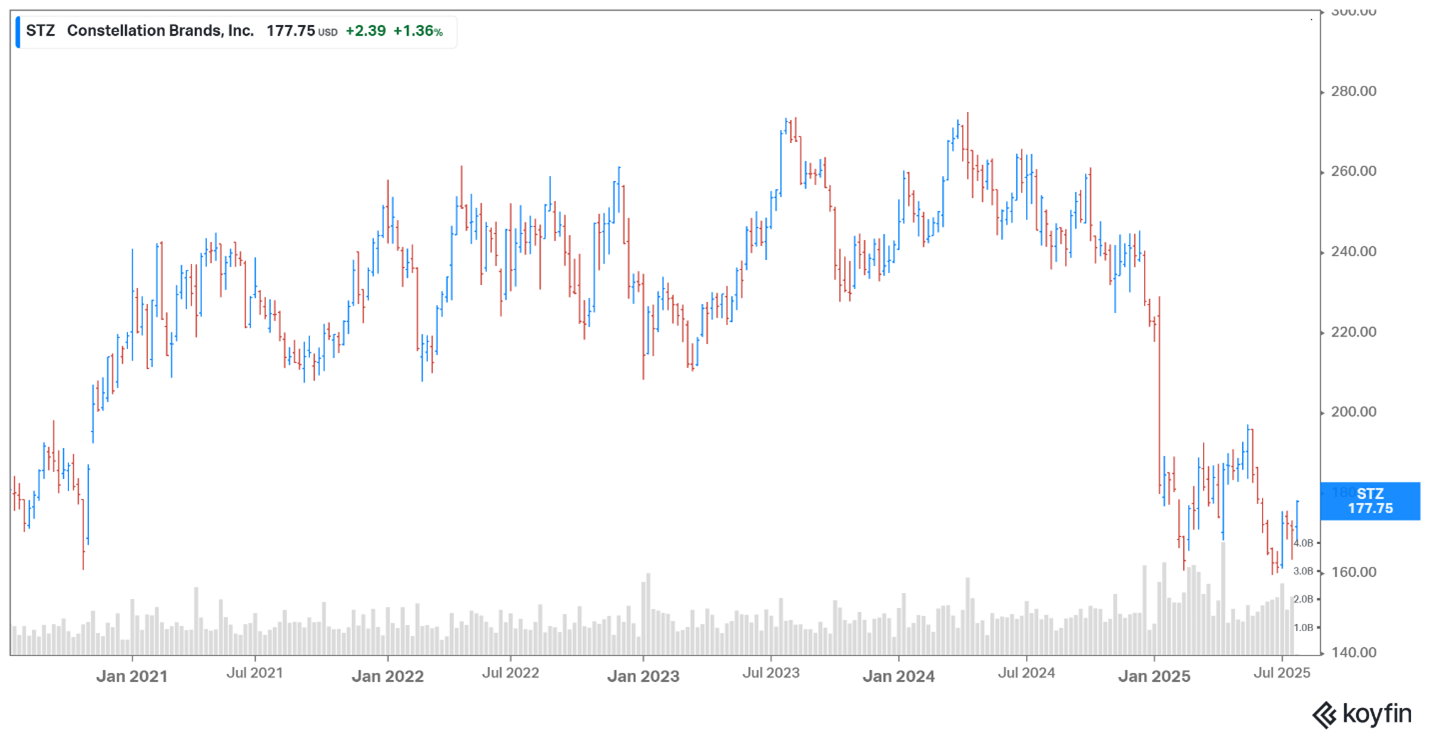
My take: When it comes to investing, the role of second and third-order effects plays an important role. So, while everyone was buying Novo-Nordisk shares, excited about how GLP-1s could improve their health, they forgot to consider the second-order implication: losing weight means eating less chocolate and drinking less beer. This has turned what were once regarded as dependable businesses into declining ones
3. UnitedHealth (UNH)
UnitedHealth Group is a leading American healthcare company that mainly operates through two key divisions: UnitedHealthcare, which offers various health insurance and benefits plans, and Optum, which provides healthcare services such as data analytics, pharmacy care, and direct healthcare delivery. They hold approximately a 23% market share in the American healthcare industry.
The American healthcare business is one of the largest profit pools in the world. Due to a combination of regulatory capture, government neglect and a legal system which creates perverse incentives – each warranting its own separate, lengthy discussion – Americans are one of the unhealthiest nations in the world, despite paying the most for healthcare on a per capita basis.
One of the biggest beneficiaries of this system was UNH. On the one hand, it receives an annual premium from its clients. On the other hand, UNH must manage an industry incentivised to bill for as many services as possible. Hospitals and doctors are paid per service and are incentivised to bill and medicate as much as possible. At the same time, the insurance company is incentivised to deny as many claims as possible and administer the least amount of medication.
Over time, UNH has done a commendable job of denying claims and increasing premiums, resulting in a growing earnings stream and a favourable premium rating.
But all good things come to an end, and over the last 18 months, bad things have happened to UNH:
- In February 2024, it was the victim of a cyberattack, costing $1.8bn.
- In December 2024, its CEO was shot in the street in New York by someone who hated the business. Never a good sign.
- In June of this year, the replacement CEO stepped down after lowering earnings guidance. Also, not a good sign.
- Just after that, the Department of Justice announced an investigation into past billing practices. At least we found out why the CEO resigned.
Not a great picture, and the once-market darling’s stock price is down by 50% over the past few months:

But GLP-1s might have a third-order effect – lower health claims. For a struggling insurance company, this might be a saving grace. Premiums are sticky – they take a long time to adjust downwards – but drugs like Wegovy have an almost immediate positive effect on people’s health.
My take: If high expectations driven by excitement are the enemy of the rational investor, neglect and disappointment leading to low expectations must be its ally. UNH is recruiting allies as we speak. I don’t own it – it doesn’t fit into my process. But I think it’s worth more than a cursory look. And potentially an excellent example of third-order effects.
4. The JSE All Share Index
This is the news:

This is the market:

In contrast to what the news will have you believe, the market is doing just fine, thank you. What’s happening?
- A dominant portion of the market is made up of gold and platinum miners, which are on a fantastic bull run now.
- Another significant part of the market consists of offshore businesses, like Naspers/Prosus, British American Tobacco, AB InBev, and Richemont, which have benefitted both from rand weakness and stronger growth in offshore economies.
- The part of the market that’s performing poorly is the one subject to our inept and useless government – retailers, banks and industrials. And especially small caps. For instance, over the past decade, everyone’s favourite retailer, Mr. Price, has gone nowhere, a lost decade indeed.
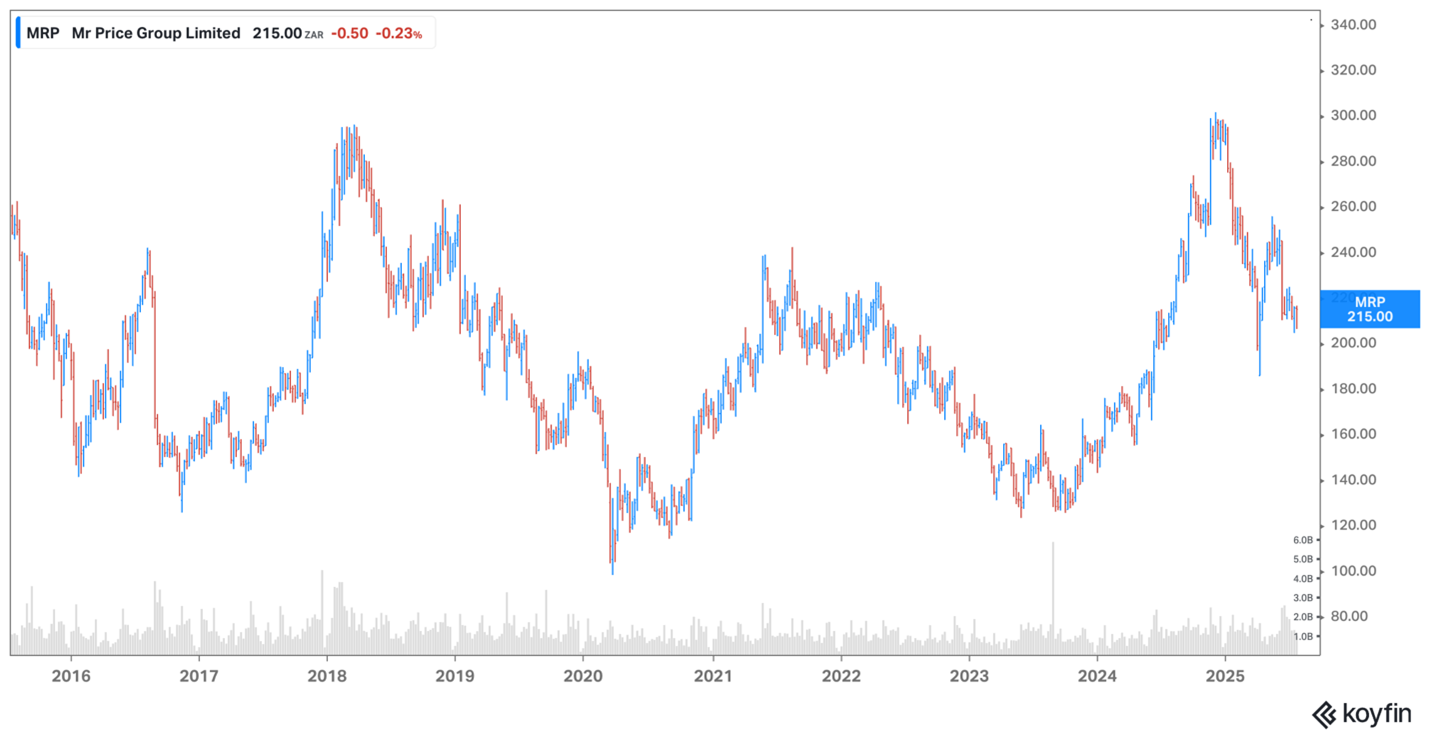
However, the valuations of local stocks have declined to a level where sharp investors are beginning to take notice. It’s quite possible that good local companies with P/E ratios of 6 or 7 already reflect all available negative news. At least, that’s what foreign investors seem to be suggesting.
If the bull market in commodities truly takes off, there will be notable positive second- and third-order effects for local businesses. Remember 2004 to 2007? If you don’t, go back and look at what happened.
Yesterday, Natco Pharma, an Indian pharmaceutical firm, expressed interest in acquiring a majority stake in the local pharma business Adcock Ingram, at a premium to the market price.
This is just another instance in a list of foreigners recently attempting to acquire low-cost local businesses, despite the negative news articles. This list is from Urquhart Partners:

Urquhart also mentioned a few situations where local insiders have tried to take their companies private (or have succeeded in doing so):
- Bell (failed – price too low)
- Ascendis (failed – price too low)
- Workforce
- Sasfin
- AH-Vest
- Cognition
- African Rainbow Capital
My take: Local investors are viscerally transfixed, living through a collapsing system and reading about it every day in the news. But they forget there are people and companies (and even some municipalities) that are fighting and overcoming the corruption-induced entropy of our failing government. In the stock market, such businesses are often priced with embedded low expectations, resulting in attractive valuations. Foreigners and insiders are increasingly capitalising on this situation.
5. The truth about the stock market
It’s not often you get to read the unadulterated truth in mainstream media, but I did come across some veracity this week. I’ll leave this here:

In The Media
1. Good news
We all know bad news sells, so you never really get to read good news in those publications you pay for. This one is free, so here is the good news:
- South Africa ranks highly in terms of culture and heritage, and the richness of a country’s culture and heritage is often what makes it unforgettable to visitors and cherished by its people. You can read more about it here.
- Cape Town was recently voted “Best City in the World” for 2025 by both The Telegraph Travel Awards and Time Out, a significant recognition of its global appeal. You can read more about it here.
- South Africa, with its Western Cape winelands as the centerpiece, was acknowledged as the world’s top wine tourism destination for 2025 by Titan Travel, further confirming its reputation for excellence. Portugal was second and Italy third.
- As mentioned earlier, our stock market is at all-time highs, outperforming most other markets in the world. More info on this fact here.
My take: Yes, we have problems. But it’s not all doom and gloom, as mainstream media will have you believe. And hey – who doesn’t have problems?
2. Ozzy Osbourne
Ozzy Osbourne – “The Prince of Darkness” – passed away this week. In the early 70s, his band Black Sabbath created an entirely new sound, a sound called “heavy metal”. Led Zeppelin were the pioneers, but Ozzy and his band cranked up the dial to 11.
I never really got into their music, and later in life, he became a caricature of himself, starring in a reality series on MTV called “The Osbournes”. For a person who became famous for biting the head off a bat in one of his shows, it was sad to see.
But even a non-fan like me must admit that Osbourne had a major impact on the music world. I mean, who didn’t head-bang to “Paranoid” in their teens? (I’m speaking of anyone over the age of 50, of course!)
You can listen to “Paranoid” on Apple Music or Spotify.
Please be cautious, though – nodding along vigorously to its beat at our age can be considered a potentially dangerous activity.
3. The best music of 1993
1994 was a special year. South Africa held its first democratic election, marking the end of Apartheid. The pictures of the long queues outside polling booths will forever remain iconic.
However, it was also the year after I was fortunate enough to upgrade my house. I had bought my first house in 1991, a modest semi-detached little place in Devils Peak – a suburb that outranks most on the Beaufort scale. At the time, having just moved down to Cape Town from Pretoria, I found property prices outrageous. Wind-free Higgovale was the aspirational suburb, but way out of reach. So, Devils Peak it was.
Until the pre-election political instability arose in 1993. Suddenly, house prices – even in Cape Town – collapsed. Almost two years after my initial purchase, I found a place in Higgovale that the owner was almost willing to give away, as he wanted to move overseas. Immediately. I scraped together everything I had and took out a mortgage I couldn’t afford, and took the plunge.
Of course, things never really got as bad as most had imagined at the time, and property prices eventually returned to normal. The net effect was that, as opposed to most residential property “investments”, this one turned out well – with the added bonus of living in a nice area.
So, the music of 1993 always reminds me of this fortunate confluence of events.
You can listen to my top 10 albums of the year on Apple Music here and on Spotify here.
- Some of the highlights were Counting Crows exploding onto the scene with Mr Jones, Cowboy Junkies extending their winning streak to three albums, Mazzy Star introducing an eccentrically modern take on the blues and Pearl Jam taking it up a notch.
- Radiohead was starting to get tired of the Brit rock thing, and on “Pablo Honey”, they were edging into the greatness of what was to come.
- PJ Harvey’s second album, “Rid of Me”, was one of my highlights of the year. It’s generally regarded as a milestone in alternative rock (if you don’t already know, my preferred genre of music). Its intensity and rawness were in complete contrast to the overproduced, polished sound of pop music in the 1990s. Listen to it at full volume.
- But the album of the year for me was Liz Phair’s “Exile in Guyville”, where she challenged the male-dominated rock scene status quo. The album was a song-for-song response to the Rolling Stones’ “Exile on Main Street”. The raw confessional lyrics and lo-fi sound set the stage for a lot of music in the 1990s and 2000s.
My top 20 songs of the year are on Apple Music here and Spotify here. As usual, they’re counted down from number 20 to number 1. “She Don’t Use Jelly” by the Flaming Lips is still one of my favourite songs ever.
The long list of best songs is only on Apple Music here.
I hope you find at least some music that brings you as much joy as the year 1993 (and the one thereafter) brought to me!
Even with the JSE All Share Index at a new all-time high of 100,000, it’s still wise to remain careful out there!
Piet Viljoen
RECM