

Dear Fellow Investors and Friends,
Welcome to another edition of my newsletter, where I share my efforts to understand markets and the world around me.
I do appreciate you taking the time to read this. Feedback is welcome; it’s great to start conversations.
Today is Thursday, July 17th, the 198th day of the year. There are 167 days until the end of the year. On this day in 1955, Disney opened the doors of “The Happiest Place on Earth” in Anaheim, California, forever changing the concept of amusement parks. I still vividly remember the magical experience of visiting it with my family when I was 9 years old.
Since then, Disney has opened a further 11 parks worldwide. These amusement parks have become an essential part of the Disney intergenerational flywheel – as a kid, you watch the movies, experience the parks, buy the merch. When you grow up, you give your kids the same experience. Rinse and repeat.
As a result, it’s a business whose stock you can own for a long time. In fact, I regard it as one of my “Forever stocks”.
“Success in investing isn’t about making a lot of money in a short period of time. It’s about earning reasonable returns over very long periods.”
– Bruce Flatt
“Discipline is cheaper than regret.”
– Shane Parrish
It’s one of the biggest conceits of our time, this certainty we have that the stock market is there “to make us rich”. How many books have been written with variations of the title: “How to get rich in the stock market” – all of them starring that trope of the stock market genius? It has become so well-embedded in the popular psyche that it has become aspirational.
The stock market has become shorthand for “easy money”. We have grown up in a world where financial markets are there to “make us rich”. The past 15 years have been the best time ever in US markets, creating high expectations:
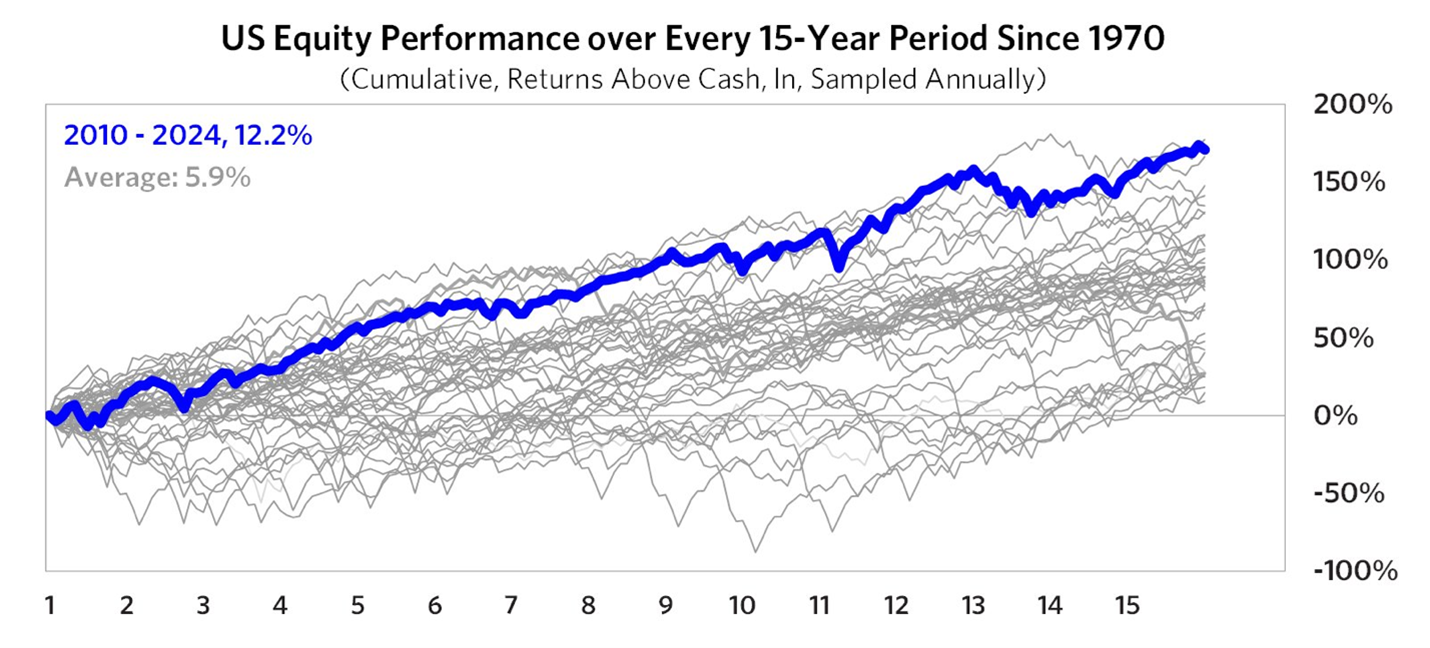
It’s no wonder people (at least those investing in the US market) think the stock market is “easy pickings.”
But here’s the bad news: you are highly unlikely to get rich by “playing” the stock market.
Why would you think buying small outside passive minority stakes in other people’s businesses, often pooled and managed by agents and intermediated by another set of agents, all with very different incentives from yours, could ever make you rich?
When you think about it, the odds are stacked against you. It’s a fool’s paradise.
Furthermore, the prices for these “outside passive minority stakes” are quoted daily and are highly volatile, presenting you with almost irresistible temptation to transact. Often. Every time you decide to transact, you create an opportunity to make a mistake. Given that the odds are so highly stacked against you to start with, many of those decisions will be mistakes. Compounding one mistake on top of another is the sure road to ruin in the stock market, as many have found out.
Even Warren Buffett, one of the wealthiest men in the world, didn’t get rich by “picking stocks” as the popular discourse would have it. Yes, he did buy some outstanding businesses, but that’s not what created his success. The story seldom told is that he built a serious insurance business that provided highly favourable financing, with which he then went out and bought stocks. The secret to his wealth lies not so much in the quality of his stock picking, but predominantly in the favourable access to financing.
And that, in a nutshell, is how you get rich. By plying your trade – whether that is a businessman building a business, a doctor or lawyer building a practice or an engineer building useful things.
A rational perspective is not to view markets as a place to get rich, but a place to stay rich.
The next bit is about a fund I manage – the MWI Worldwide Flexible Fund, which I have nicknamed “The Cockroach.” So, if you don’t want to read what is at best a thinly disguised piece of marketing, please skip to the next section.
You’re still here? Good.
My answer to the question of “how does one use the markets to stay rich?” is The Cockroach.
In my view, there are two elements to staying rich:
- Returns above inflation in hard currency terms.
- Returns that have a low volatility profile.
Building a fully diversified portfolio is the only way to earn returns above inflation, with low volatility, consistently. Diversified not only amongst asset classes, but also within asset classes – the implication here is that you are not swinging for the fences, but eking out singles, consistently, no matter the market environment.
The Cockroach is a portfolio that is “prepared for anything yet prepared for nothing in particular”.
It’s a globally diversified portfolio that contains some assets that protect against inflation and others that benefit from inflation. It also holds some assets that protect against deflation and others that benefit from deflation. And so on.
What this means in practice is that it will never shoot the lights out, as it will, by design, always contain assets that are not benefitting from the current environment.
The alternative method commonly applied is to attempt to earn fantastic returns by forecasting what the future will look like and then building a portfolio that will 100% benefit from this forecast. This method has a proven low success rate. At any point in time, there is always a fund that is performing exceptionally well, based on getting the forecast right. But it is rarely the same fund next time. And not the time after that. Or most times into the future.
Of course, there are a few exceptions which prove the rule. But these are only really clear after the fact. While building their track record, these funds may appear too different, volatile, or risky to invest in.
Which brings me to my next rule for staying rich in the stock market. It’s simple: You need to survive for a long time to stay in the game for a long time. I wrote about this in “Ergodic no more”.
If you look back at a stock market chart, all previous corrections look like a little blip. At the time, those blips were enough to scare many people out of the market, causing them to sell at precisely the wrong time. And the hardest thing to do once you’ve sold is to time your entry back into the market.
My solution: Keep The Cockroach’s return volatility low. Again, the way to do this is by running a fully diversified portfolio. Low volatility means low fear, and fear is the enemy of the long-term investor.
And the long-term investor is ultimately the winner.
Markets
1. Walt Disney
Disney’s share price has been under pressure over the past few years, mainly as a result of the “streaming wars,” where competitors seeking to challenge Netflix had to incur significant capital expenditures just to stay in the game.
But Disney seems to have weathered the storm – its free cash flow is improving, after the capex-induced slump post 2020:

As a result, the share price is responding positively, but still has lots of work to do:
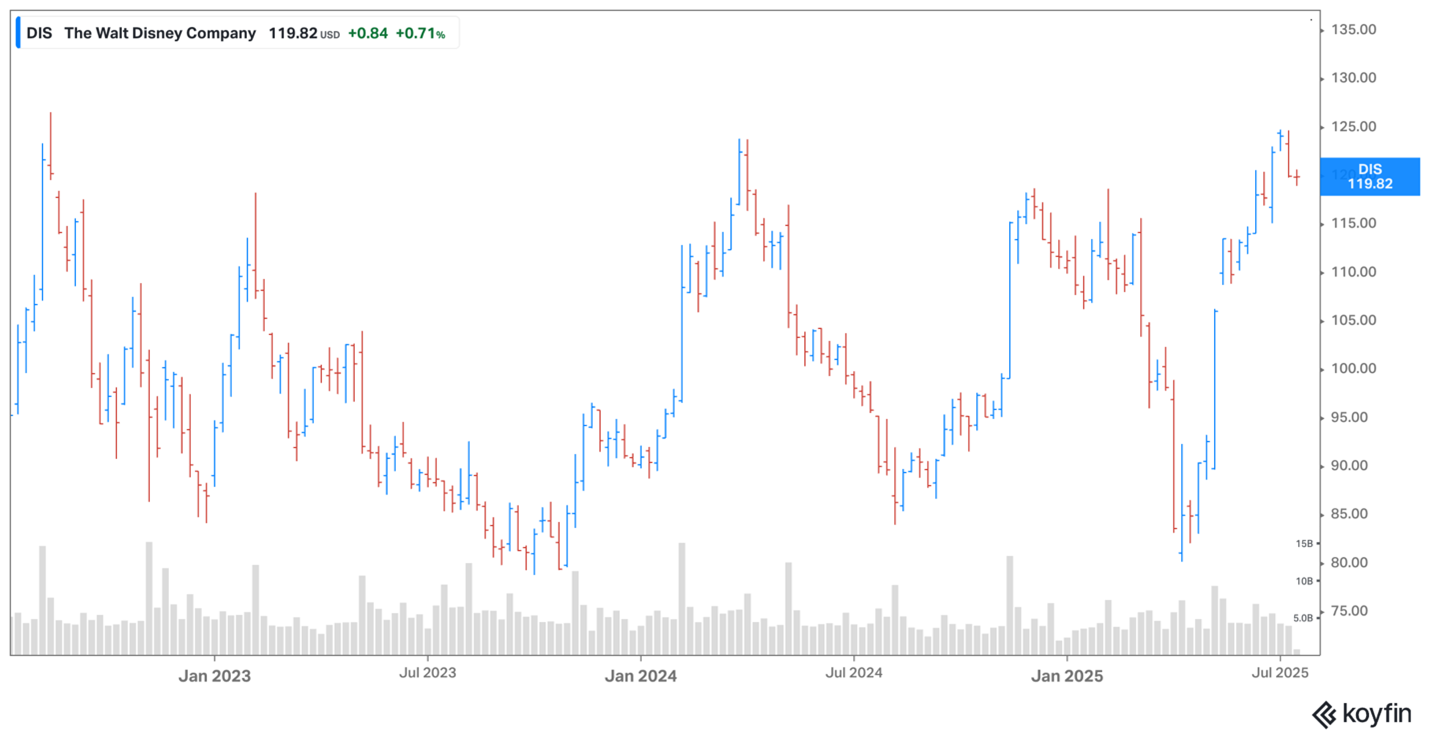
There is some concern about a decline in holiday travellers to the USA. There is no doubt that America is currently an eye-wateringly expensive experience for anyone in the world who doesn’t earn US dollars. Stories about out-of-control border agents make the prospects of visiting the country even less attractive.
This could also hurt Disney, as “Experiences” is the term Disney uses for its amusement parks, which make up the bulk of their operating income.
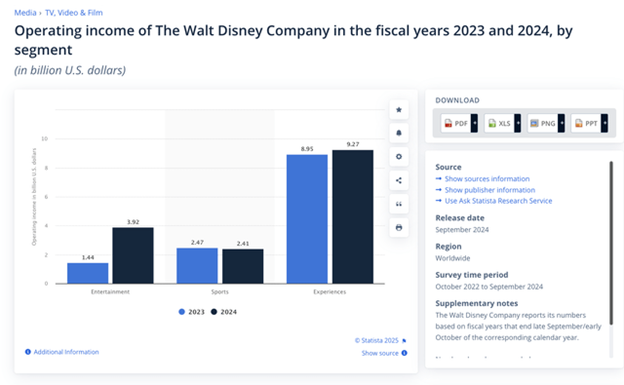
However, the flip side of the argument is that international visitors only make up 20% of the visitors to Disney World, so a decline in numbers won’t be cataclysmic. Some of that spend might even be redirected to their international parks.
My take: Disney is a fundamentally strong company with invaluable IP. If any company can weather the storms capitalism visits upon its members regularly, it’s this one. That’s why it’s a core holding in the equity allocation of the MWI Worldwide flexible fund – aka “The Cockroach”.
2. Wärtsilä Oyj Abp. / Ørsted A/S
Who?
Wärtsilä is a Finnish company which manufactures and services power sources and other equipment in the marine and energy markets. Yes, they make engines for ships.
Ørsted is the largest energy company in Denmark, and is the world’s largest developer of offshore wind power by number of built offshore wind farms.
Apart from their interesting spellings, the two companies share another commonality: both are energy transition plays.
For Wärtsilä, there’s an ongoing opportunity to benefit from propulsion retrofits. Increasing numbers of operators are exploring the replacement of their traditional diesel propulsion systems with alternative fuels, such as ammonia, LNG, and methanol, and there is growing interest in hydrogen as a longer-term alternative fuel source.
Ørsted, on the other hand, is taking advantage of Europe’s determined efforts to transition from an efficient but dirty energy source to a cleaner but inefficient power source.
It looks like the market has cottoned on to the weakness in the arguments behind the drive to “renewable energy”. Here’s Ørsted’s share price:
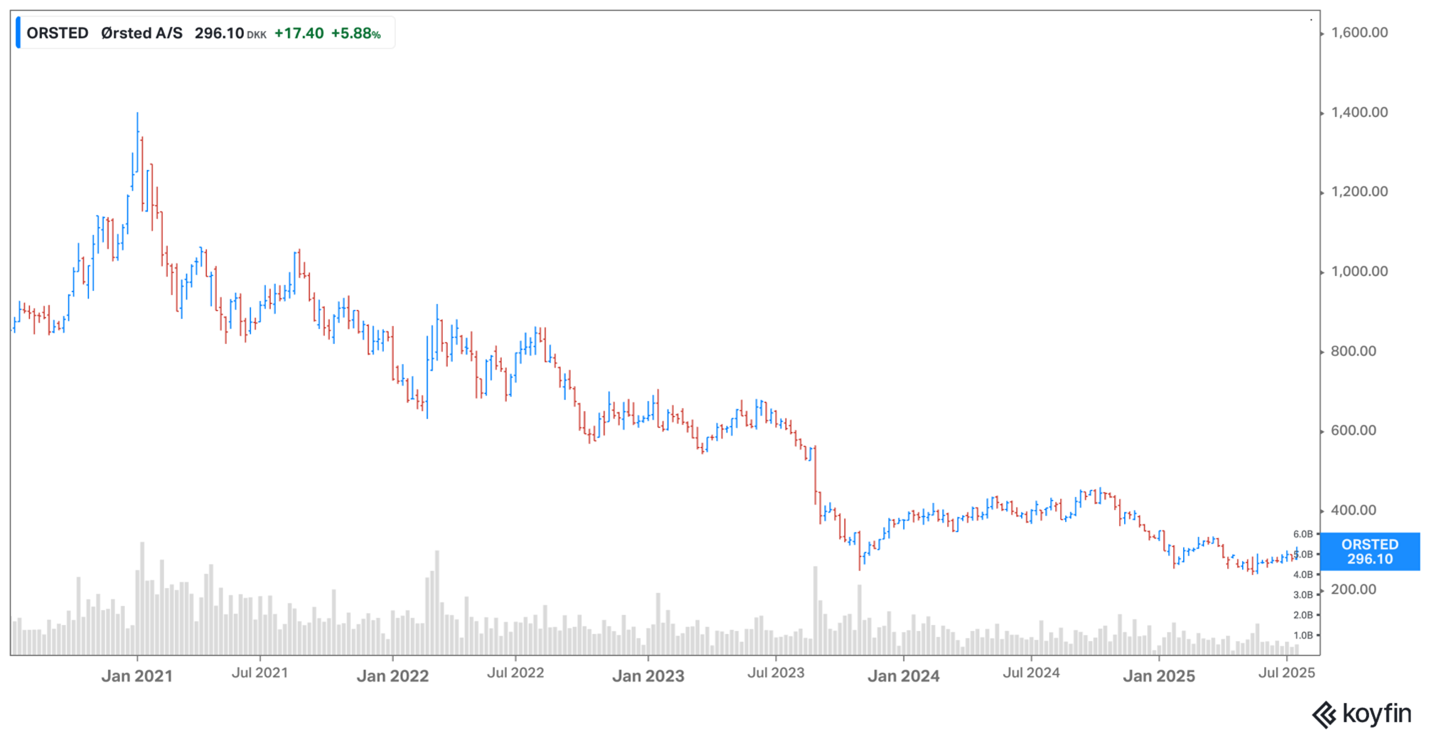
And here’s the share price of that old economy maker of ship engines:

My take: The market is starting to see through this whole energy transition boondoggle. Invest accordingly.
3. Nippon Steel
Speaking of old-economy businesses, it doesn’t get more old-economy than a Japanese Steel business, which finalised the takeover of US Steel last month in a $15 billion transaction.
The deal featured an interesting twist: the US government was allocated a “golden share”, granting it extraordinary veto power over key company decisions. Truly American capitalism with Chinese characteristics!
In this way, the US government retains some control over a key industrial input – especially key if you’re making weapons, of course! It’s probably a good outcome for the US economy, especially when considering the travails of the old South African steel business, Iscor. ArcelorMittal bought the company and eventually ran it into the ground. Aided and abetted by the infrastructure collapse overseen by our useless government.
But there are specific longer-term implications from the greater government involvement in business that this transaction portends. Implications which we can draw from the Chinese:
- The government supports businesses that become too big to fail, draining resources from other potentially more productive enterprises and leading to lower growth.
- Fewer corporate defaults, as governments keep their interests alive with virtually unlimited funding.
- A decline in the value of contractual assets relative to tangible assets, as governments are generally not great at keeping to their side of any bargain when conditions change materially. Trust levels decline.
My take: It’s never been wise to bet against the US economy and its businesses. But there is a slow creep of increasing government influence, which never ends well anywhere in the world. A core holding of physical gold can help hedge against a negative outcome here. The MWI Worldwide Flexible fund – aka The Cockroach – has 15% allocated to physical gold.
4. Copper
Dr. Copper hit a new all-time high this week, as President Trump made another of his series of tariff announcements. This time, it’s a 50%-er on all copper imports. Given that he has a track record of raising, lowering and postponing previous tariff announcements, who knows where this one will end up?
But the copper price jumped to its highest ever level as a result:
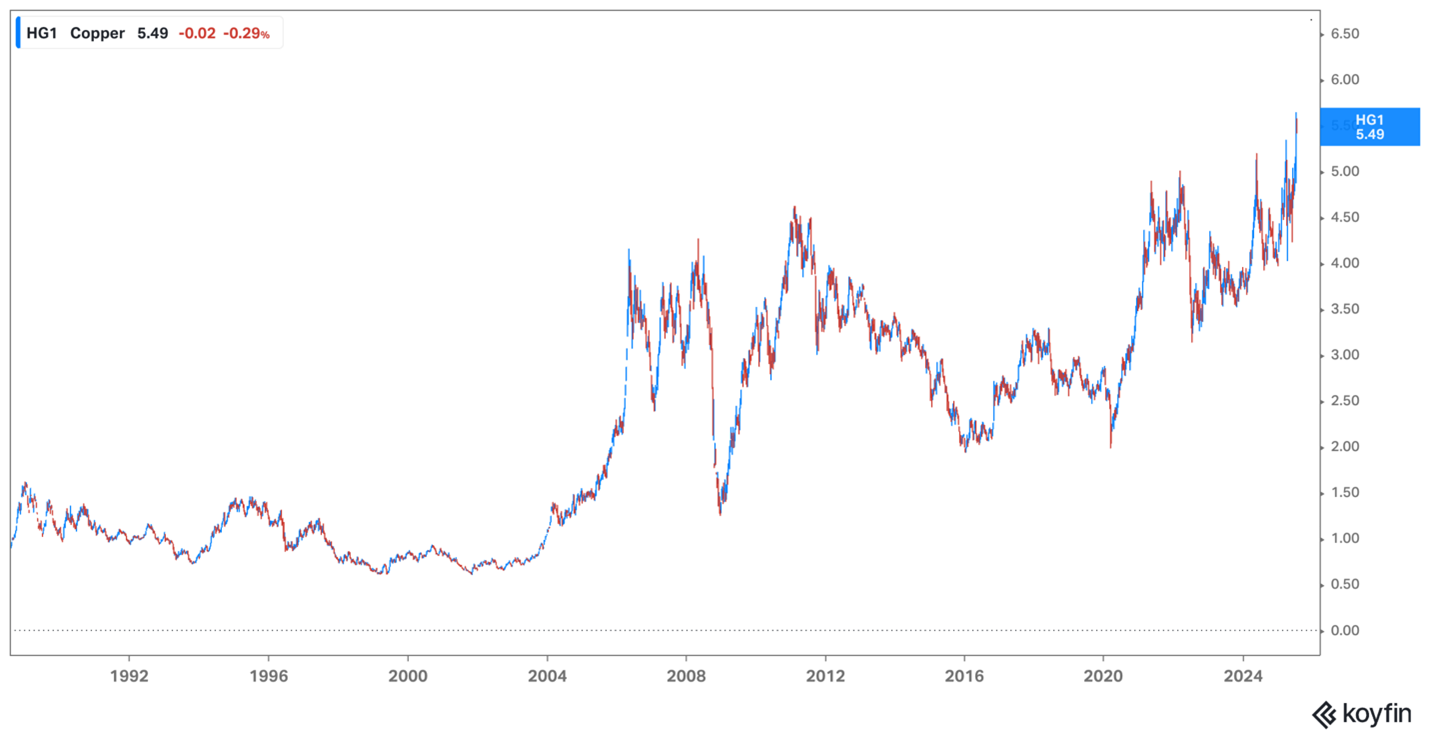
My take: I think there are two important implications here. Firstly, copper is an essential input into most manufacturing processes, particularly those related to electrification. A significantly higher copper price is inflationary. Secondly, an increasing copper price also indicates a healthy economy – the demand for the metal increases when there is more economic activity. So, I would be cautious of the fear-mongers who always expect the next recession to be just around the corner. Dr Copper says it’s not happening.
5. Nvidia
I don’t own this stock. I’ve never owned this stock. And if I write that 100 times, all it would do is make me feel like Bart Simpson:

Nvidia is one of those stocks that often appears expensive but consistently outperforms, despite its valuation. To own it, you have to believe a few things:
- They will continue to be able to weave together their proprietary software and advanced chips to ward off any current competition.
- Their extreme profitability will fail to encourage any other future competition.
- Management won’t make a strategic misstep at some point.
- A new technology that supersedes theirs won’t be developed in China.
- The government won’t ever impose limiting regulations on them.
- Energy costs won’t become a limiting factor.
Realistically, the odds of any of those negative things happening are not super high, so those who hold the stock might be proven correct. But neither are the odds zero, which keeps me from buying the stock.
To my detriment, as you can see from their share price:

My take: A ten-bagger in 5 years! And from the most significant business in the world by market cap – what’s not to like? Well, it’s trading on 28 times sales, which doesn’t leave much room for any of the potential disappointments mentioned above. Or any other setbacks which I can’t even imagine. In the meantime, if you own it, enjoy the ride.
I don’t own the stock
I don’t own the stock
I don’t own the stock
I don’t own the stock
I don’t own the stock
I don’t own the stock
I don’t own the stock
I don’t own the stock
In The Media
1. Morgan Housel – The cost of ego
Ego is the enemy of any investor. The market has a way of making you think you are the smartest guy in the room, just before it whacks out the pedestal from under your feet. In this podcast, he discusses how to strike a balance between confidence and humility, as well as the importance of maintaining realistic self-awareness.
The money quote:
“It’s like the humility to know that you need to work hard because you are a nobody, and the confidence to know that if you put one foot in front of the other, you can actually improve your circumstances.”
You can listen to it on Spotify here.
2. Luminate
Luminate’s 2025 Midyear Music Report is now available. This year’s deep dive unpacks the critical forces reshaping the music industry in the first half of the year. For anyone interested in music or the music business, this report unpacks all the key trends so far in 2025.
Some highlights:
- R&B / hip-hop is the most popular form of music.
- Country music grew the most in current streaming, while R&B / hip-hop declined year over year. Music tastes are shifting.
- Worryingly, 1 in 3 US music listeners report being “somewhat” or “very” comfortable with the use of generative AI to create song instrumentals.
- “Becoming Led Zeppelin” is the top music documentary in 2025.
- The top song, with 1,9 billion streams, was Lady Gaga and Bruno Mars with “Die with a Smile”.
- The top album with 2,6 billion streams was by country singer Morgan Wallen, “I’m the problem”.
That’s just a taste, there’s a treasure trove of interesting info in the report, which you can access here.
3. Tour de France: Unchained
This is a series on Netflix that is in its third season. The series provides insights into what goes on behind the scenes with many of the teams involved in the world’s greatest race.
The series is released every year in conjunction with the Tour de France, so the new season was released last week. Amanda and I watched the whole thing in two sittings. It makes for riveting viewing, even if you already know the results (the series always deals with the previous year’s race).
This time of year brings me a lot of joy – The Tour de France, the Knysna Oyster Festival, Wimbledon and Bok rugby. It is the highlight of my calendar, despite the mostly rainy and gloomy weather here in Cape Town.
And we have the summer to look forward to!
But please remember to be careful out there.
Piet Viljoen
RECM