

Dear Fellow Investors and Friends
Welcome! I do appreciate you taking the time to read this.
I’m Piet Viljoen, and today is Thursday, the 16th of May, the 137th day of the year. There are 229 days left until the end of the year.
Our heroes are leaving the stage. Last week, Jim Simons died. “Jim, who?” you might ask. Jim started one of the first quantitative hedge fund companies, Renaissance Technologies. One of their funds, the Medallion fund (only available to employees!) returned 66% a year for thirty years, generating more than $100 billion in trading profits.
Jim tells his life story: “I did a lot of math. I made a lot of money. And I gave almost all of it away.”
Jim was an investment hero, not a rockstar fund manager. He seldom gave interviews and shied away from the public eye. But he was one of the most successful investors ever. He didn’t publish a book on principles, but he did have the following sensible advice:
- Don’t Run with The Pack
- Hire the Smartest People
- Don’t Give Up Easily
- Be Guided by Beauty
- Hope For Good Luck!
By contrast, “The modern financial services industry is designed solely to serve itself, and it exists almost entirely for one purpose: the extraction of fees and commissions from the investing public. In fact, we are all locked in a constant zero-sum battle with this behemoth.”
– William J. Bernstein, The Four Pillars of Investing
A few weeks ago, in “Stoic WP”, I described the rise, fall and rise of RECM. During the “fall” part of that journey, an article was published in one of the financial papers with the headline “Rock star fund manager fizzles out.”
Of course, below the tagline was a picture of me – which my son found very funny at the time. He was 12 or 13, and it was mainly because he had never thought of his father as a “rock star” in the first place.
But I grew up in an industry where the “rock star” fund manager was the thing that brought in AuM (Assets Under Management) for the firm, so whether you liked it or not, the rock star image was promoted by the firm. In fund management, AuM is everything.
Fees were around 1%, basically going to the fund management company, the only pig at the trough. It was a great business, and I’m very thankful for the opportunities it presented. The industry was lightly regulated, with minor internal compliance departments and reasonable licensing fees. The chain of helpers between the client and the fund manager was short.
As a result, fund management businesses were highly profitable, and fund management companies changed hands at high prices. They were desirable assets. The bonuses for those “rock star” fund managers weren’t bad, either.
Of course, there were scandals. Famous cases of front-running, insider trading and other forms of self-dealing. That’s human nature – there’s always someone who will figure out how to game the system and has no shame. Every time there was a scandal, calls for more regulation, more transparency and more “accountability” rang out.
So, we got what we wanted.
Today, a whole industry has developed around that original trough, all jostling for position, all in the interest of “serving the client”. The financial advisor, the DFM, the fund platform, the fund manco, the custodian, the administrator, the regulator and yes, the fund manager all need to get paid – because they are all working hard to make sure the client comes first.
Some of it comes from the fund manager’s 1%, but most of it is on top. Today, the fund manager is the lowest part of the food chain; a mere widget maker. The days of the rock star are long gone.
Fund managers now work in cookie-cutter teams, employed by cookie-cutter firms, all desperately trying to hang on to their clients by huddling around the index. Like a herd of antelope, they find safety in numbers, too scared to stray too far for fear of being picked off by one of the circling predators – yet more helpers who are all “looking out for the client” – for a fee, of course.
Today, the industry is intermediated, risk-managed, regulated, and complianced to within an inch of its life. It has become complicated, risk-averse, and expensive. Clients are arguably worse off.
How did this happen?
A latticework of rules and regulations has been implemented in reaction to previous infractions by the fund management industry. These all originated with good intent but have many unintended consequences, which can – and often do – force fund managers into irrational actions.
The net result is that, unwittingly, everyone gets the index minus an ever-increasing fee charge. Under these circumstances, asset consultants allocating their client’s assets to a mix of incumbent fund managers is, at best, irresponsible. Conscious, inexpensive indexing should play a far more significant role than unconscious, expensive indexing.
I also believe there is room for active managers. Not rock stars throwing stuff at the wall and hoping something sticks, but managers willing and able to do something different from the herd. Managers adding value by painting outside the lines from time to time. Yes, this does mean that some mistakes will be made. Yes, this means that not every quarter will be good.
But you can’t deliver alpha by doing what everyone else is doing.
Active management means betting on multiple situations where the odds are in your favour. Not every wager pays off, and some might take a long time to do so. And some never pay off. But over a sufficiently long enough period, a portfolio of favourable wagers – which looks very different to the market – should deliver a satisfactory outcome. It takes skill to pick and patience to stay with these wagers.
Today, due to the herding and concentration induced by “risk management” considerations, the market offers many such favourable wagers. Investors who understand this and are patient enough to stay the course stand a good chance of earning returns well above the market.
Allocating the bulk of one’s assets to a broad, cheap index, with some active fund management supplementing that allocation, strikes me as a sensible way to deal with the current conundrum presented to clients.
Possibly, even Jim would approve of such a process.
“New lows are bearish”
I’m not bearish. There are no new lows worth discussing. It’s a bull market.
“New highs are bullish”
1. Teck Resources
As discussed in “Head Office Blues” last month, Dr. Copper predicts a rosy future on the back of spineless politicians. Be that as it may, BHP confirmed the good doctor’s prognosis by bidding for Anglo American two weeks ago, mainly for its copper assets.
Teck Resources is amongst the world’s most attractive pure-play copper producers and would also be a decent acquisition target. Its share price seems to be expecting another one after Glencore’s recent aborted offer for the group:
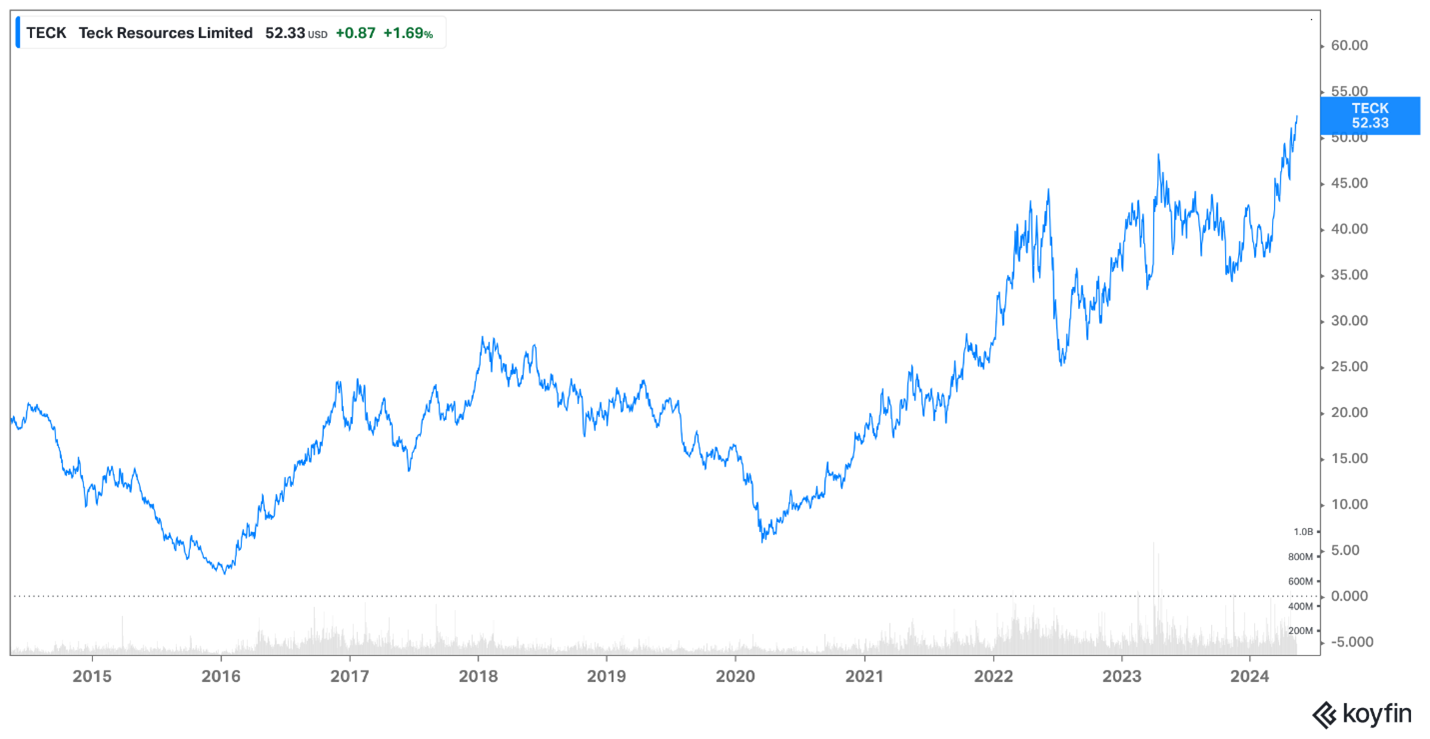
Teck has a sensible commitment to return 30 – 100% of available cash flow to shareholders. It has a share buyback program of up to 16% of shares in issue. As opposed to most mining companies, Teck is doing the rational thing. Buying itself, not some other unknown business that makes for good headlines but poor economics.
My take: If you’re bullish on copper, this is one to own.
2. Naspers
I have been quite vocal about China and its stocks in a negative way.
In short, I believe that by buying Chinese stocks, you put yourself in the position of the frog that asked the scorpion for a lift across a river. When the scorpion stings it in the middle of the traverse, the frog asks, “Why did you do what you said you wouldn’t? And the scorpion answers – I’m a scorpion, that’s what I do.
But now Naspers is making new highs. It’s forcing me to think about my view. I might even have to change my mind; this chart looks so bullish:
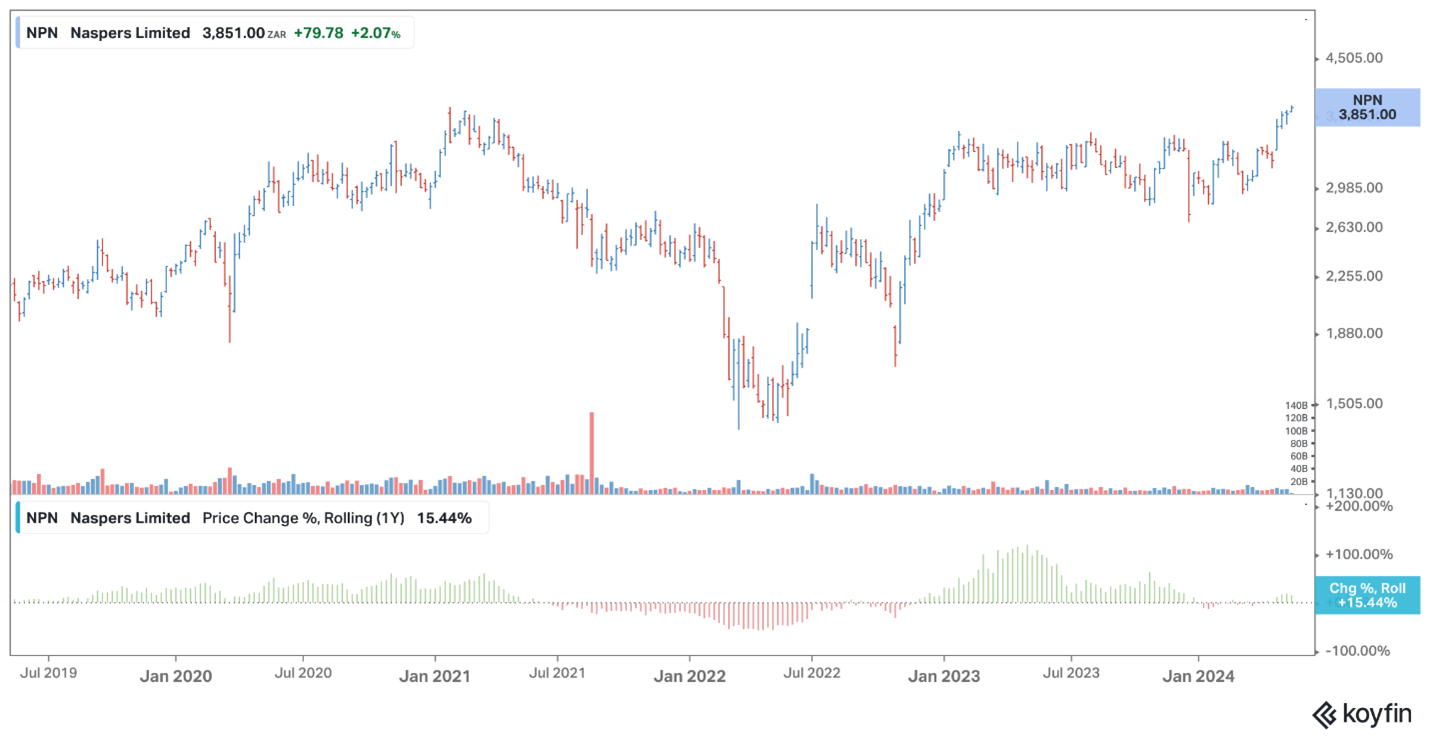
My take: This is an issue for me. It’s causing me sleepless nights. When (if?) I change my mind, I will communicate my thinking here. For now, it’s still “eerder bang Jan as dooie Jan”.
3. Merchant West Investments Global Value Fund
I am happy to report the fund hit a new high yesterday. I am even happier to report that this fund has performed very well since the merger of RECM with Counterpoint and Bridge, which together formed Merchant West Investments. It’s up by over 10% p.a. in US$ since mid-2020 when the merger was consummated in the throes of the pandemic. I still remember getting to know my new colleagues via Zoom. It was a tough way to merge firms, but it has worked beautifully.
Today, most of the firm’s funds are in the top quartile over three years, and the five-year numbers are also starting to look promising.
This particular fund came in for a lot of criticism, with the value style of investing being out of favour and all that. But even without Nvidia, it has held its own against the benchmark index. The 4 and a bit year performance is pretty good, if I may say so myself.
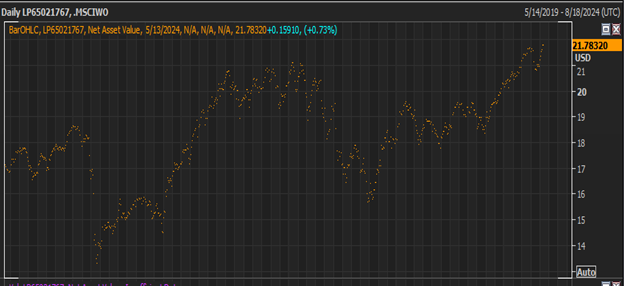
I am even happier to report that, at this high point, I am handing over the fund’s management to Sean Peche of Ranmore Asset Management fame.
My take: Sean is a much better fund manager than I am, and the fund will thus be in excellent hands. His track record is exemplary. He will do a great job, better than all the cookie-cutter institutions.
Did you know?
1. Things change
In the 15 years between 1907 and 1922, horses went from providing 95% of all private vehicle miles travelled on American roads to less than 20% (rethinkx.com). This picture tells the story:
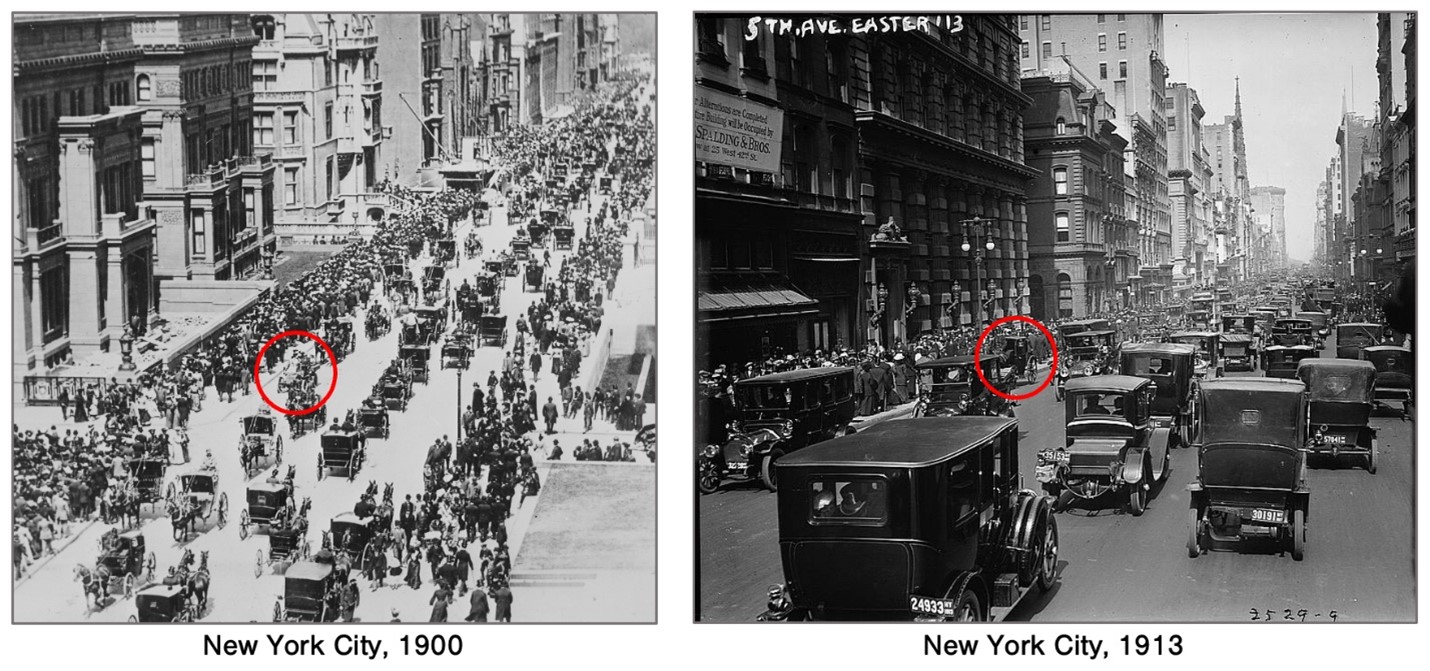
In the left-hand picture is one motorised vehicle; on the right, there is one horse-drawn cart (both circled). In 13 years, motorised cars went from being scarce to ubiquitous.
My take: When a new technology becomes convenient, affordable, and accessible, it gets adopted very quickly. The Ford Model T did this for internal combustion engines. What are the chances that BYD does this for EVs?
Speaking of which…
2. Zeekr lists in the USA
Zeekr is the premium brand of Chinese automaker Geely, which also owns Sweden’s Volvo Cars and the U.K.’s Lotus. It was formed in 2021 and has delivered nearly 200,000 cars, mainly in China, though it’s looking to expand to other markets, given the increase in domestic competition. It IPO’d in the USA this week.
There is a lot to digest here.
Firstly, the irony is that the first Tesla was built on a Lotus chassis. And I bet you that all the soccer moms driving around in their safe, Swedish SUVs didn’t know they were driving a Chinese car.
Secondly, Zeekr listed just as the USA imposed 100% tariffs on Chinese EVs.
Finally, Russia’s Vladimir Putin might visit China’s Xi Jinping. Washington is threatening exporters and banks in China with “consequences” should they help to bolster Russia’s military capacity.
My take: Cheap, good-quality Chinese EVs will become common in the “Global South” over the next few years. These tariffs increase the chances of that. Secondly, and more importantly, what started as tariffs on technologically sensitive products, like computer chips, is now expanding to many other goods. Watch this space. It’s getting ugly out there. Trade wars are good for no one.
3. There is not a lot of gold around
In John Authers’ Bloomberg column this week, he illustrated how little gold has ever been mined. In the column, he points out that if all the gold ever produced were melted down, it would fit into a cube with sides of 20 metres. This valuable object would easily fit into the hold of a modern tanker. When you think about it – really think about it! – it’s super impressive how small the volume of gold is that has been produced through the ages. Also, gold is quite heavy. If this cube of gold were actually put in the hold of said tanker, it would sink.
My take: Scarcity has ensured the price of gold maintains its purchasing power over time, unlike fiat currencies, such as the ZAR or the US$. What else is scarce? Bitcoin has programmed scarcity – food for thought.
What I’m reading
1. Chartmetric
If you’re interested in music, this site has all the stats around the industry you would ever want or need.
One interesting tidbit: “Artists on Spotify have uploaded a combined 871.78 years of music to the platform, which is nearly twice the amount of time as there was between Leonardo Da Vinci painting the Mona Lisa during the Italian Renaissance and Beyoncé releasing her 2022 album RENAISSANCE.”
My take: there is a lot of music out there. To make it big in that industry is super hard. Many talented artists never get a look in. But for a music consumer, the music world is a wonderful place to discover and enjoy so much.
2. About a time we never knew
This article hit home. I had never thought properly about how growing up with technology and social media can affect one’s state of mind. This piece highlighted certain aspects of it to me.
In it, the author references the word anemoia, meaning nostalgia for a time or a place one has never known.
I like new words, and that’s a good one.
My take: As a Boomer, I have tended to be hard on Millennials / Gen Z’s. I never understood their fears and anxieties. After all, we just got on with things; why can’t they? But I think we can all agree that social media changes things, and the psyche of those who have grown up with it is one of those things.
What I’m listening to
Neil Young and Crazy Horse just released a new album called Fu##in’ Up. The album features live versions of the 1990 album Ragged Glory.
This is a picture of the band:
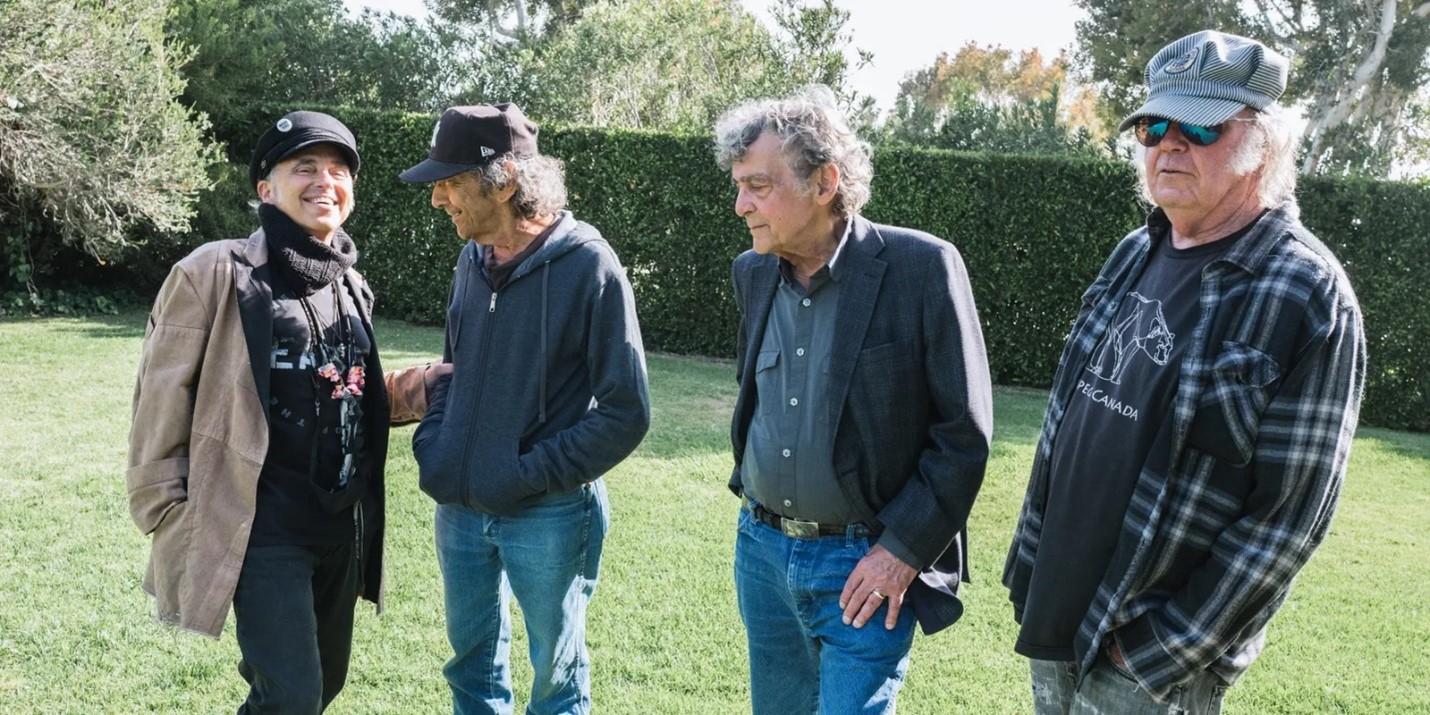
These are not fresh-faced, young pop stars. But they kick ass. You can listen to the album on Apple or Spotify.
My take: Neil Young was the OG grunge artist. Listen to this album, then listen to Neil Young play with Pearl Jam on the album Mirrorball on Apple or Spotify.
What I’m watching
1. Neil Young
While we are on the Neil Young topic, here is a video of him playing the hard-hitting song “Keep on Rocking in the Free World” with Pearl Jam.
Turn up the volume and watch to the end. The sound Neil Young gets out of his guitar should probably be outlawed.
My take: This is raw rock ‘n roll. Spine-tingling.
2. Dan Schultz interviews author Sebastian Mallaby
Mallaby has written three books: The Man Who Knew, More Money than God and The Power Law. All three are well worth reading. However, this interview gives insight into his thinking about how the asset management industry has developed over time, the role of regulation and how technological change happens and impacts us. It’s an hour well spent.
My take: Understanding history gives you an unfair advantage in life. Mallaby helps develop that advantage.
Be careful out there; the Russians are coming!
Piet Viljoen
RECM